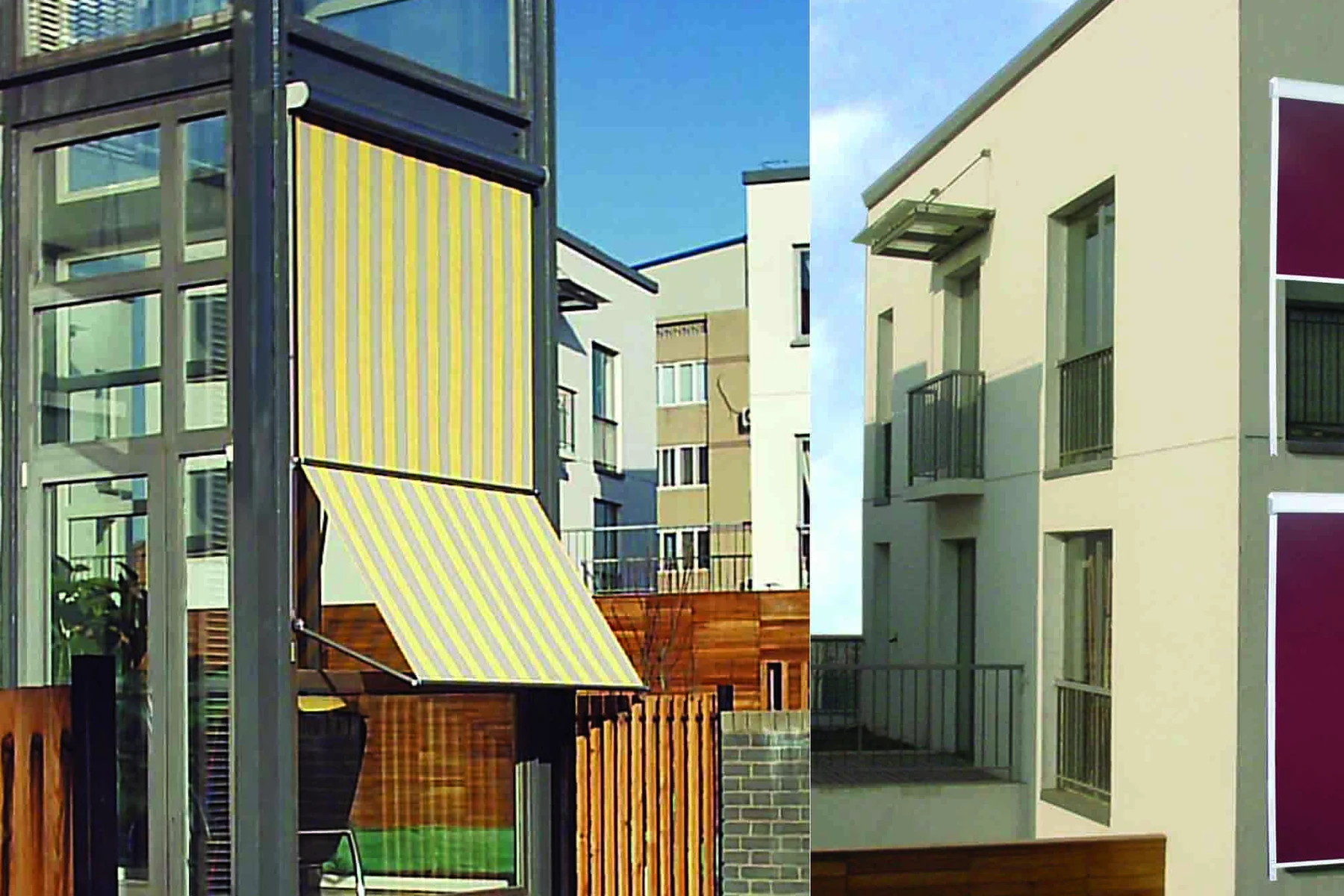
1. What a fixed awning is good at
A fixed awning is installed in a permanent projecting position. It may be a fixed-frame canopy, a fixed-arm window awning, or another fixed exterior shade structure. The format can be direct and visually consistent because there is no extended operating envelope to plan.
Fixed shade can suit windows or entrances where the same sun-control position is useful throughout the year and the projection will not obstruct movement, daylight, views, or maintenance access. Fewer moving parts can also simplify the product specification and the user routine, although fixing, wind exposure, cleaning, and material durability still require proper design.
- Shade position remains predictable
- No motor, crank, remote, or retraction routine
- Projection occupies space permanently
- The fixing and canopy must be designed for site exposure
2. What a retractable awning changes
A retractable awning extends from a roller and can be closed toward the building. Folding-arm and cassette formats achieve this differently: a conventional folding-arm awning leaves more of the roller and arms visible when retracted, while a cassette encloses more of the mechanism in a housing.
Retraction protects the canopy when it is not in use and restores clear space above doors, windows, terraces, or shopfronts. That flexibility is useful when solar exposure changes, the outdoor area is used seasonally, or the facade needs a less projected appearance for part of the day. It also creates moving components and an operating policy that the owner or facilities team must follow.
3. Decide from the daily use, not the product label
Start with the hours when the space is used and the direction of the sun. A fixed awning may provide the right result when one permanent projection shades the important part of a window, entrance, or terrace. A retractable system becomes more useful when the required shade changes, the awning would otherwise block views or light, or the area needs to be opened for another function.
Do not assume that a retractable awning is automatically more suitable because it moves. Moving systems introduce controls, motors, arms, fabric rolling, service access, and operating habits. Conversely, do not select a fixed canopy without checking whether its permanent projection conflicts with doors, furniture, deliveries, cleaning, or the way the window opens.
- Which windows or outdoor areas need shade, and for how long?
- Will the projection obstruct a door, view, walkway, or service access?
- Does the owner want a permanent visual line or a stowed system?
- Who will extend, retract, clean, and inspect the awning?
- Is power available if motorized retraction would be useful?
4. Check fixing, projection, pitch, and exposure together
Both formats depend on a suitable fixing substrate and a safe arrangement of brackets. The visible wall finish does not prove that it can carry the awning. Confirm what lies behind the surface and have the installing contractor approve the anchor method for the selected model, dimensions, and site exposure.
For either format, mark the proposed width, projection, mounting height, front-bar height, and nearby obstructions on a photo or simple elevation. Check the awning when open and, for a retractable system, when closed. Confirm that the cassette depth or folding-arm profile fits the available wall, lintel, fascia, or underside.
Wind is a design and operating condition, not a product-name guarantee. A fixed canopy may remain exposed continuously, while a retractable awning needs a clear policy for retraction and supervision. A wind sensor can support automation, but it does not make either format a storm shelter.
OPENING CHECK
Draw both the open and stowed positions.
Include the awning, door or window swing, lighting, drainage, walkways, and the space needed for operation and service. This exposes conflicts that a width and projection alone will miss.
5. Build an RFQ that makes the comparison concrete
Send a dimensioned elevation or clear photos with the opening size, usable fixing width, required projection, mounting height, fixing substrate, site exposure, and quantity. State whether the shade must be available every day or only part of the time, and whether the opening must be clear when the awning is not needed.
For a fixed option, ask for the proposed projection, pitch, frame or canopy construction, fixing detail, and maintenance route. For a retractable option, add the model family, operation preference, power route, control method, stowage clearance, and service access. If multiple openings are involved, number each one; nominal repetition can hide different fixings and clearances.
- Open and stowed clearance
- Permanent or intermittent shade requirement
- Fixing substrate and site wind exposure
- Manual, motor, remote, or sensor preference
- Fabric or finish reference and required lifespan expectations
KEEP SPECIFYING
Move from the format decision to model and size.
Compare folding-arm, cassette, and window systems, then verify projection and the opening dimensions.
Frequently asked questions
Are fixed awnings always cheaper than retractable awnings?
A fixed design can avoid motors, controls, and some moving components, but installed cost depends on the frame, canopy, fixing work, size, access, and performance requirements. Compare complete project specifications rather than the awning label alone.
When is a retractable awning the better choice?
A retractable awning is useful when shade is needed intermittently, when the opening should be clear after use, or when a facade benefits from a stowed system. Confirm clearance, operation, power, service access, and the wind operating policy before choosing it.
Can a fixed awning be converted to a retractable awning?
Do not assume conversion. The existing fixing, frame, dimensions, structure, and installation may not suit a retractable model. Treat it as a new system review with current brackets, clearances, and load requirements.
Which awning is better for windows?
Use a fixed window awning when one permanent projection suits the sun and clearance conditions. Use a folding or compact retractable window awning when the projection must close. Outward-opening sashes, handle positions, and headroom must be checked either way.
Does a retractable awning give better weather protection?
Retraction lets the canopy be protected or removed from the extended position, but it does not make the system suitable for permanent rain or storm exposure. Confirm the fabric, pitch, drainage, model limits, and operating policy.
What information should a fixed versus retractable quote include?
Ask for the system format, width, projection, pitch, fixing method, frame or cassette detail, canopy reference, operation, controls, operating limitations, service access, and whether dimensions are confirmed for the project.