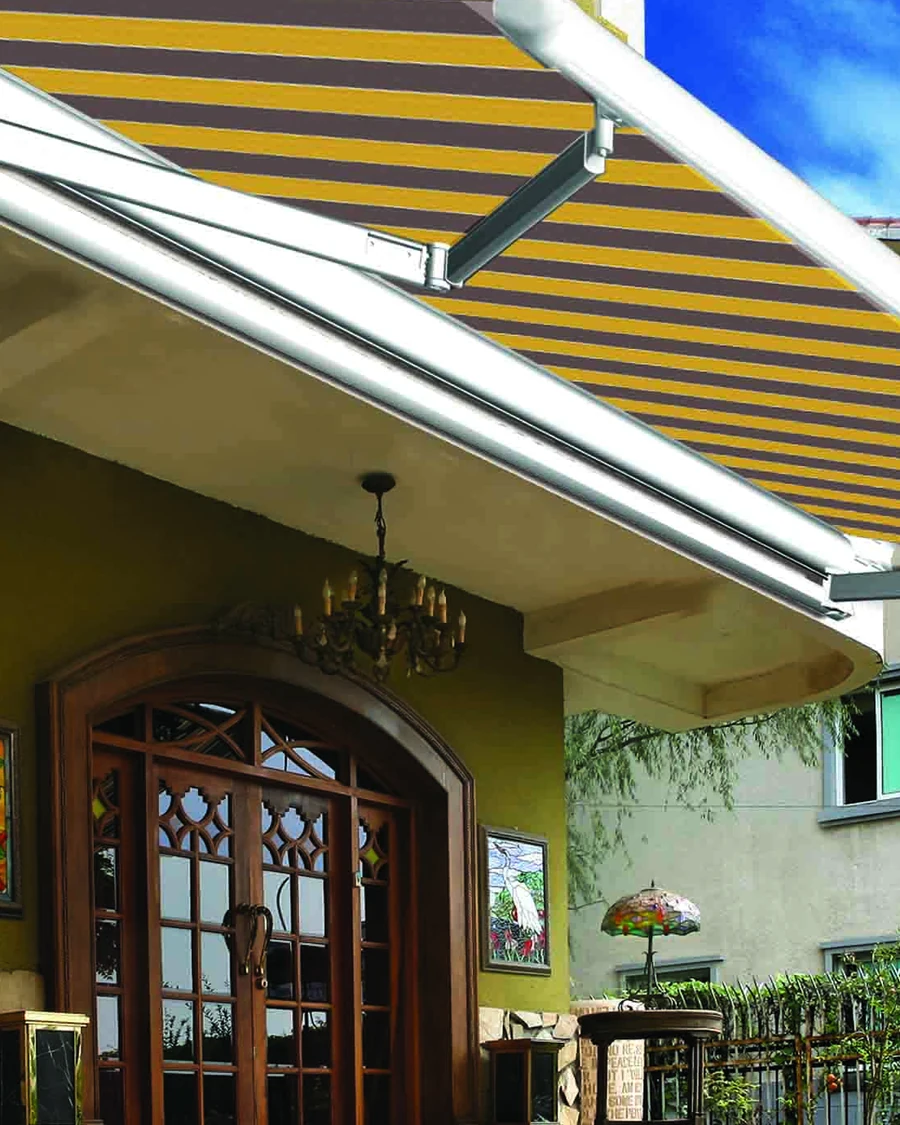
1. Manual retractable awning: simple mechanics, direct control
A manual awning uses a crank or another operator to move the fabric and arms. It is direct, understandable, and does not require an electrical circuit. This can be useful for smaller openings, retrofit projects, or installations where power cannot be planned practically.
The trade-off is handling effort and access. Check the operating height, crank position, furniture clearance, and how often the awning will be extended. A long or frequently used canopy may become inconvenient even when it is mechanically suitable.
- No dedicated motor circuit or remote pairing
- Clear manual operating position is still required
- Users must follow the manufacturer's operating limits
- Future motorisation should not be assumed without model review
2. Motorized and electric awning: convenience and integration
A tubular motor can be combined with a wall switch, handset, or selected control system. Motorized patio awnings are often convenient for larger spans, hospitality spaces, high openings, or sites where many users operate the shade.
Plan the electrical route before construction is complete. The motor location, service access, receiver position, switching method, cable entry, isolation, and compatible sensor options all need coordination with the selected model. A motor does not remove the need for an operating policy in wind or rain.
3. Wind and sun sensors support a policy; they do not replace one
Sensors can automate extension or retraction and help a building follow a consistent routine. They cannot make an awning a permanent storm shelter or guarantee that every gust, rain event, or power interruption is handled safely.
If sensors are specified, define the intended response, override method, maintenance responsibility, and behavior after a power interruption. For hospitality and commercial installations, the user guide should be practical for staff who operate the space every day.
4. Plan the operating system for B2B distribution
Distributors and fabricators need a coherent control platform across models. Consider which remotes, receivers, motors, sensors, cables, and spare parts must be supported in each market. More control choice can improve fit, but it also increases inventory and technical-support complexity.
Use one reference system for sales samples and document the available control combinations by model and size. That reduces mismatched orders and makes the quotation clearer for the installation team.
5. What to include in an electric awning RFQ
State the width, projection, model preference, mounting surface, operating height, preferred switch or remote, power availability, site exposure, quantity, destination, and required control features. Include a photo of the proposed switch and cable location if available.
- Manual, switch-operated, remote, or sensor-led operation
- Available voltage and power route
- Number of awnings and control groups
- Required spare parts and user documentation
- Warranty and service-access expectations
KEEP SPECIFYING
Compare the awning formats that can carry each control.
Folding-arm and cassette systems differ in stowed appearance, mechanism protection, and installation planning.
Frequently asked questions
Can a manual awning be converted to motorized operation later?
Some systems may support conversion, but it depends on the model, tube, motor, brackets, and control design. Confirm with the current technical data before promising an upgrade.
Are motorized awnings better for restaurants?
They can be convenient when staff operate multiple awnings or larger openings, provided power and control access are planned. Manual systems can still be appropriate for smaller or low-use installations.
Does a wind sensor make a retractable awning storm-proof?
No. A sensor can support automatic retraction, but the awning still has operating limits and is not a permanent storm shelter. Site exposure and user procedure remain important.
What power information is needed for an electric awning quote?
Provide the available voltage, cable route, proposed switch or remote location, number of units or control groups, and any local electrical requirements for the destination market.